

If you want better gut health, start by feeding your gut bacteria with fibre, not by trying to add new ones with probiotic pills. Most probiotics do surprisingly little, and fibre is the part almost everyone gets wrong. Here is what the evidence actually supports, with fibre in the lead and a couple of supplements that genuinely add something.
Why most probiotics do so little
Your gut flora is an enormous population of bacteria, and most of it lives without oxygen, meaning it is anaerobic. Probiotic supplements mostly deliver aerobic bacteria, the kind that do use oxygen. That is a mismatch from the start.
The scale is the real problem. A capsule holds a few billion bacteria, while your gut is home to trillions. Trying to steer a population that large with a handful of billions rarely shifts the balance in a lasting way.
This does not mean probiotics are useless. After a course of antibiotics, or with certain specific complaints, they can offer some support. But as the foundation for everyday gut health, they are not the best place to begin. Feeding the bacteria you already have works better than trying to move new ones in.
Fibre: the real foundation for your gut flora
The helpful bacteria in your large intestine need food, and that food is fibre. Fibre is a group of carbohydrates your body cannot break down, so it passes through to your gut, where your bacteria happily feed on it. This is what people mean by prebiotics: fuel for your microbiome. Give your gut flora enough fibre and the good bacteria grow on their own.
Fibre does more than feed bacteria. A diet with plenty of it tends to:
- keep you fuller for longer, so you get hungry less quickly
- help keep your blood sugar steadier
- support healthier cholesterol levels
- feed the bacteria that matter for your gut lining
There are broadly two types: soluble and insoluble fibre. You need both, and a varied diet delivers them without much effort. Wholegrains, pulses, vegetables, fruit and nuts are all rich sources. One practical note: build your fibre up gradually. Going from very little to a lot in a single day can leave you bloated for a while.
Athletes: watch out for a fibre gap
There is a catch here, and it hits hardest if you train a lot. Many people who lift or exercise seriously eat very high protein and, in the process, push carbohydrates and fibre to the side. Protein is essential, no argument there. But you can get quite far without much fibre, and that is exactly where things go wrong.
Getting far is not the same as being at your best. A long-running fibre shortfall can throw your gut flora out of balance and, over time, weaken your gut lining. A high-protein diet is not automatically a healthy diet.
If you drink a lot of whey or other protein shakes, check that you are still getting enough fibre from real food. A good shake does not have to crowd out your fibre; the fix is simply to pair your protein with a fibre-rich meal rather than treating the shake as the whole meal.
How much fibre do you need a day?
The general guideline for adults is roughly 30 to 40 grams of fibre a day. Most people fall well short of that. The good news is that ordinary food gets you there comfortably. A few sensible swaps already make a real difference:
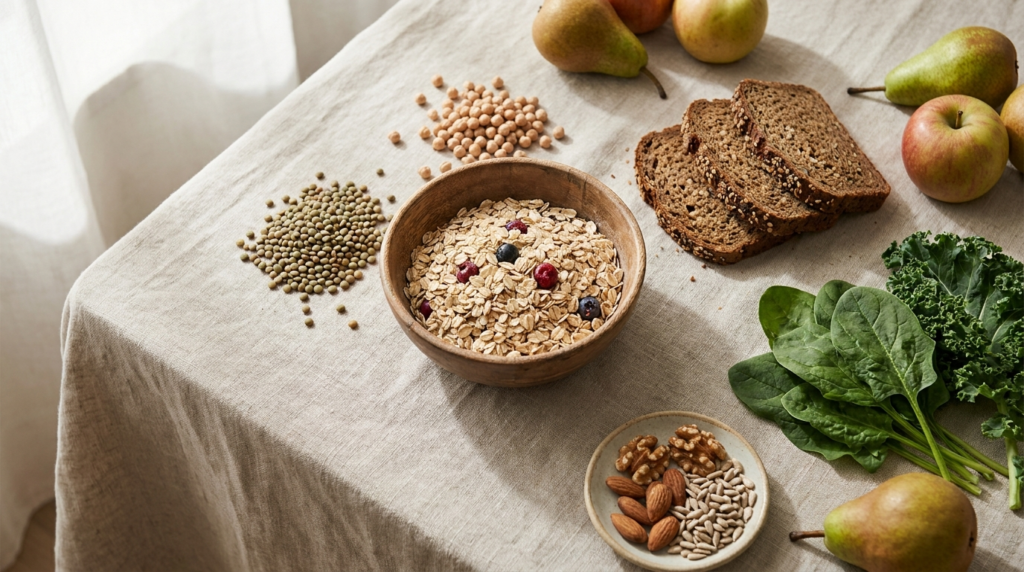
- porridge or oats at breakfast
- pulses such as beans, lentils and chickpeas
- wholemeal bread and wholewheat pasta instead of white
- vegetables with every cooked meal
- fruit and a handful of nuts as a snack
If you genuinely cannot hit your fibre target through food, a fibre supplement can be a useful top-up rather than a daily essential.
Fibre as a supplement: psyllium husk
The best-known fibre supplement is psyllium husk. It is a soluble fibre that holds on to water and adds bulk in your gut. Psyllium husk can help with sluggish bowel movements and gives a fuller feeling. It is cheap, simple and well studied, which is a rare combination in the supplement aisle. A basic tub of psyllium husk typically costs only a few pounds and lasts a long time.
One rule matters: always drink plenty of water with any fibre supplement. Without enough fluid, fibre can do the opposite of what you want and leave you more constipated, not less.
Be wary of the hype around “fibre maxing”, the idea that more fibre is always better. It is not. Too much fibre at once causes discomfort, and above a certain intake you gain very little extra. Build up slowly and let your gut adjust.
Which supplements actually help your gut?
Alongside fibre, a small number of supplements have reasonable evidence behind them for gut and general health. Keep it simple and choose based on what you actually need:
- Fibre (psyllium husk) if you cannot reach your daily fibre through food
- Glutamine, an amino acid that plays a role in the gut lining and is sometimes used by athletes training intensively
- Omega-3, which can help lower inflammation and supports your overall health
This is not a list to take all at once. Start with your food, add only where it is genuinely needed, and keep things manageable.
Bloating and gut trouble? Check these triggers
Sometimes the issue is not too little fibre but something that actively irritates your gut. A few common culprits are worth ruling out:
- Polyols and sweeteners such as xylitol and maltitol, often found in “sugar-free” products and some protein bars
- FODMAPs, a group of carbohydrates that can cause symptoms in sensitive guts
- Lactose, the milk sugar that not everyone digests well
- Gluten, a trigger for a proportion of people
If you often feel bloated after a shake or after sugar-free snacks, sweeteners or lactose are logical suspects. Sometimes the fix is nothing more complicated than switching to a different product.
Frequently asked questions
Do probiotics actually work or not?
For most people, probiotics are not the best starting point. They mainly deliver aerobic bacteria, while your gut flora is largely anaerobic, and a capsule’s few billion bacteria are tiny next to the trillions already in your gut. In specific situations, such as after a course of antibiotics, they can offer some support, but they are not the foundation of everyday gut health.
How much fibre do I need each day?
The guideline for adults is roughly 30 to 40 grams a day. Most people sit well below that. Ordinary food gets you there without much trouble if you include wholegrains, pulses, vegetables, fruit and nuts.
What is the fastest way to improve my gut health?
Start with fibre from real food and eat varied meals across the day. Build your intake up gradually rather than all at once, because your gut bacteria do best with variety and need a little time to adjust.
Do I need a fibre supplement?
Not necessarily. If you already get your daily fibre from food, a supplement adds nothing. If you consistently fall short, psyllium husk is a cheap, well-studied option, just make sure you drink plenty of water with it.
Is more fibre always better?
No. Too much fibre at once tends to cause bloating and discomfort, and above a certain intake you gain very little extra. Increase it slowly and keep your fluid intake up.
Why do I feel bloated after my protein shake?
Sweeteners such as xylitol and maltitol, or lactose in some shakes, are common triggers for bloating. If it happens regularly, try switching to a product without those ingredients and see whether the symptoms settle.