

You need more than the 0.8 grams per kilogramme the government recommends—unless you barely exercise. That figure is a survival minimum, not a target. If you strength train, do cardio, want to lose fat, or are getting older, aiming for 1.6 to 2.0 grams per kilogramme makes far more sense, and science backs it up.
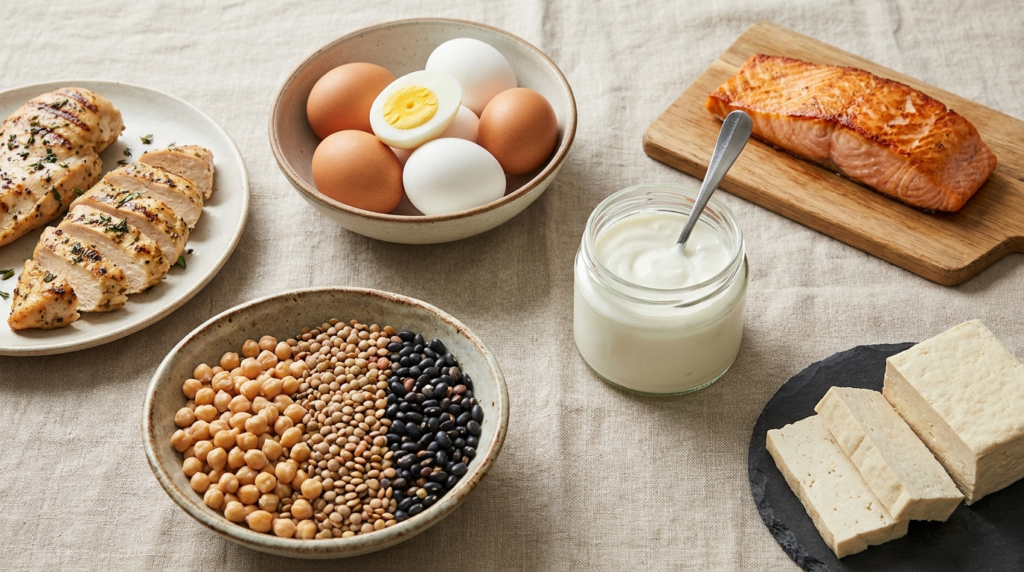
How much protein per day? A breakdown by goal
Protein is measured in grams per kilogramme of body weight per day (g/kg). Here’s a realistic guide:
- Maintenance (lightly active): 0.8 g/kg. This is the official minimum to avoid muscle loss.
- Strength and muscle building: Around 1.6 to 2.0 g/kg. Regular resistance or cardio training breaks down muscle protein, so you need generous intake to repair and grow it back.
- Fat loss: Aim higher, around 2.0 g/kg. Protein is satiating and protects muscle mass while you’re losing fat.
- Older adults: At least 1.0 to 1.2 g/kg per health guidelines, though often higher in practice because muscle preservation becomes critical with age.
The upper limit from research sits around 3.0 g/kg—which is extremely high. You’d have to be exceptionally deliberate to reach it. For most people, aiming for around 2.0 g/kg strikes a sensible, safe balance.
Why 0.8 grams is probably too low
The official 0.8 g/kg recommendation comes from older research measuring nitrogen balance. Proteins are among the only molecules in your body that contain nitrogen, so scientists estimated minimum intake by measuring how much nitrogen leaves through urine and working out how much you need to stay in balance.
The problem: you lose protein by other routes too. Through your skin, sweat, faeces, and sloughed intestinal tissue. Those pathways weren’t properly accounted for, so 0.8 g/kg is likely an underestimate.
There’s another issue: that figure assumes an average, lightly active person—someone who doesn’t exercise much. If you eat around that minimum, you’re operating on a tight margin. Think of it like a salary that barely covers groceries and rent with no buffer. If you want to build or preserve muscle, a bit more headroom makes far more sense.
Why protein matters (especially for your muscles)
Proteins are chains of amino acids. There are 20 in total, and nine of them are essential—your body can’t make these, so you must get them from food.
You use protein for more than just muscle: hormones, enzymes, immune function, and cell structure all depend on it. Yet muscle mass is where the biggest benefit lies, especially as you get older.
Unlike carbohydrate (stored as glycogen) or fat, your body has no convenient protein reserve. Your muscle mass is your reserve. When protein intake drops for a while, your body literally breaks down muscle tissue to meet its needs. Muscle loss can accelerate surprisingly fast. Since muscle mass and strength correlate strongly with better health in later life, adequate protein helps you hold onto that insurance policy.
Common protein myths, debunked
You’ll hear concerns about high protein intake damaging your kidneys or liver. The evidence doesn’t support this in people with healthy organs. Research shows no harm from protein intakes well above 2.0 g/kg in normal populations. Kidney or liver disease is a different story—if you have either, your doctor will guide you—but for healthy people, higher protein is not a danger.
Another myth: you can only use so much protein per meal. The evidence suggests your body can process and use substantial amounts in one sitting. Don’t worry about spacing protein evenly if it doesn’t suit your schedule; total daily intake matters far more than the pattern.
How to estimate your own needs
Multiply your body weight in kilogrammes by your target g/kg. If you weigh 80 kg and aim for 1.8 g/kg, that’s roughly 144 grams daily—about 30 grams per main meal. That’s easily achievable with chicken, fish, eggs, dairy, legumes, or plant-based options. If cost is a factor, compare price per gramme of protein across sources; many supermarket staples offer solid value.
If you train hard, aim higher. If you’re older or trying to lose fat, a higher target helps. And if you’re just maintaining and don’t exercise, 0.8 g/kg is the minimum safety net, though most people feel and perform better with a bit more.
Frequently asked questions
Is high protein intake bad for my kidneys?
No. In people with healthy kidneys, research shows no harm from high protein intake—well above 2.0 g/kg. If you have kidney or liver disease, your doctor will advise differently, but for most healthy people, this is a myth.
Can my body only use a certain amount of protein per meal?
No. Your body can digest and use substantial protein amounts in one sitting. Total daily intake matters far more than how you spread it across meals. Eat what fits your schedule.
What's the absolute upper limit of safe protein intake?
Research suggests around 3.0 g/kg, which is extreme—you’d need to try very hard to reach it. For practical purposes, 2.0 g/kg is a safe, high ceiling for most people.
Do older adults need more protein?
Yes. Health guidelines recommend at least 1.0 to 1.2 g/kg for older adults, often more in practice. Muscle preservation becomes critical with age, and adequate protein helps prevent age-related muscle loss.
Why is the 0.8 g/kg recommendation so low?
It comes from old research measuring nitrogen balance in lightly active people. It’s a bare minimum to avoid deficiency, not a target for health or performance. Most active people need considerably more.
How do I know how much protein I'm actually eating?
Check labels or use a food tracker. A rough guide: 100g chicken breast has about 31g protein; one egg has 6g; 200ml milk has 7g. Multiply your target g/kg by your weight and divide by three to find your rough per-meal goal.