

To bulk healthily, eat in a small surplus of around 10% above your maintenance calories, hit roughly 2g of protein and 1g of fat per kilo of bodyweight, and gain weight slowly so most of it is muscle rather than fat. A “dirty bulk” where you pile on 10kg in six months is nearly all fat. A controlled lean bulk, paired with proper training, sleep and gut health, gives you a far better result.
How big a calorie surplus do you need?
A healthy bulk runs on a positive energy balance: you eat a bit more than you burn. The key word is “a bit”. A useful rule of thumb is a surplus of no more than 10% above your maintenance calories. Your body rarely needs much more than that to build muscle.
If your maintenance is 3,000 kcal, a lean bulk sits around 3,300 kcal. Eat well beyond that and the extra mostly turns into fat, not muscle.
One caveat: calculators are only a starting point. Some people have a faster metabolism and genuinely need more to gain. Others need less than the numbers suggest. The honest approach is to track your own weight over a couple of weeks and adjust from what you actually see, not from a formula.
How much should you gain per week and per month?
On a lean bulk you want to gain slowly, so as much of that gain as possible is muscle and as little as possible is fat. A sensible structure is to plan a block of, say, 16 weeks. At the end, check your weight and body-fat, then decide whether to keep going or take a short cut.
The scales alone are not the full picture. How much muscle you can realistically build depends heavily on your training age. A beginner responds fast to lifting and gains quickly. For an experienced lifter, a few kilos of genuine muscle across a whole year is already a solid result, so patience matters.
Lean bulk vs dirty bulk
A dirty bulk means eating whatever is going: lots of sugar, little structure, fast weight gain. The result is usually close to pure fat, which is exactly what you do not want.
A lean bulk is controlled: a small surplus of around 10%, your macros in order, and attention to food quality. You gain more slowly, but most of it is muscle. Carbs are easy to over-eat, which is precisely why they are worth watching. Keep sugar in check and get enough fibre.
Your macros: protein, fat and carbs
Always work from your macros. The basics: 1g of protein is 4 kcal, 1g of fat is 9 kcal, and 1g of carbohydrate is 4 kcal.
A workable split (using an 80kg lifter on 3,000 kcal as an example) looks like this:
- Protein: around 2g per kilo of bodyweight. For 80kg that is 160g, or 640 kcal.
- Fat: around 1g per kilo. For 80kg that is 80g, or 720 kcal. Slightly lower is fine if you prefer.
- Carbs: the rest. In this example that leaves roughly 1,640 kcal, or about 410g of carbs on a training day.
On rest days, eat a little less, roughly 300 kcal lower, because lifting burns fewer calories than most people assume. Protein is easy to reach through everyday food, and a shake can help top it up if you fall short.
Watch your fat sources and your fibre
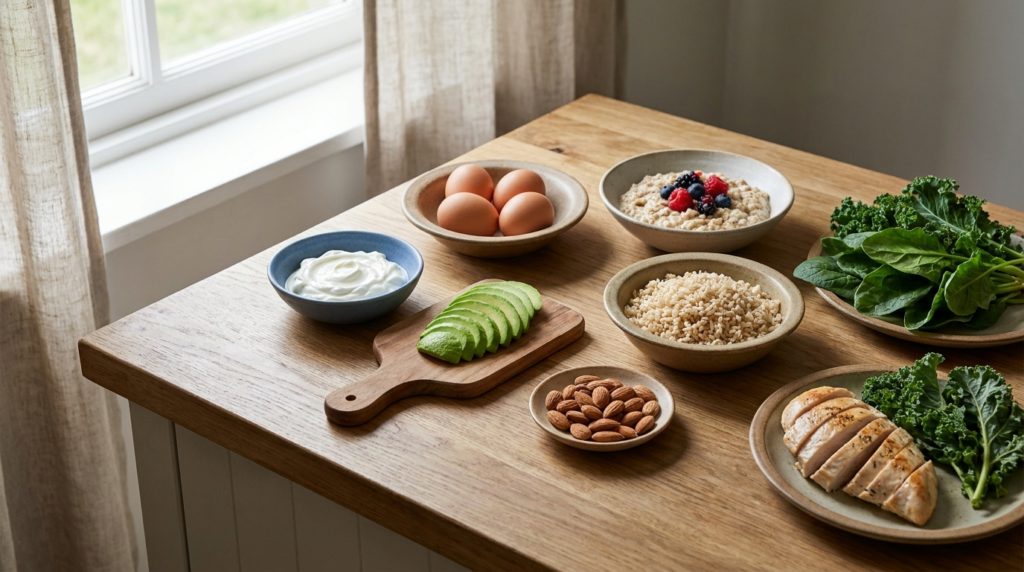
Fats play a role in your hormones, so aim for variety rather than living on olive oil alone. Think eggs, dairy, avocado, nuts and nut butters.
With carbs, keep an eye on sugar and prioritise fibre. Gut health matters more than most bulking guides admit: your digestion affects how well you absorb protein, fat and everything else you eat. Poor gut health can even knock your mood, because hormones are produced in the gut too. Getting enough fibre and staying regular, going at least once a day, is a genuine part of a healthy bulk.
Training: progressive overload and a split you’ll stick to
Training is the catabolic part: you stress your muscles with training, and they recover stronger during feeding and rest. That is why the right stimulus counts.
Which split is “best”, push-pull-legs, upper-lower or full-body, matters far less than picking one you enjoy and can keep up. Do allow roughly 48 hours of recovery per muscle group if you train naturally; legs often need three to four days.
Focus on progressive overload: more weight, more reps or more volume over time. Train hard, ideally to within a rep or two of failure, and cap it at around 20 working sets per session so it does not become excessive. Logging your lifts is worth the effort: it shows whether you are actually getting stronger, and that keeps you motivated.
Sleep, recovery and stress
Your body works around the clock, so it is no surprise it needs roughly a third of the day to recover. Aim for around 8 hours of sleep. Only a small share of people genuinely function well on 6. After a heavy leg day you may need 9 or more. Your training is often the best gauge of recovery: if you can hit the same weight under the same conditions, you are on track.
Stress works against you. It raises cortisol, which sits opposite the testosterone you rely on to build. Try to lower mental stress with something simple, like 5 to 10 minutes of breathing or meditation a day, and go easy on excess caffeine.
Cardio, steps and consistency
Cardio is not just for cutting. It is good for your heart, your fitness and your insulin sensitivity, which helps nutrients get where they are needed. Aim for around 100 minutes a week, for example four sessions of 25 minutes. On top of that, daily steps, a guideline of 10,000 and at least 6,000 to 7,000, support digestion and gut health.
The last piece is the most important: consistency. Make a plan, plan your day, take progress photos and track your weight. Build the routine up gradually so it fits your real life. That is how you keep a healthy bulk going for months.
A note on cost
Bulking on wholefoods does not have to be expensive: eggs, oats, rice, chicken and frozen veg are among the cheapest sources of protein, carbs and fibre in any UK supermarket. A protein shake is a convenience, not a requirement, and only worth buying if it genuinely helps you hit your daily protein.
Frequently asked questions
How big a calorie surplus do I need to bulk healthily?
Aim for a surplus of around 10% above your maintenance calories. If your maintenance is 3,000 kcal, that is roughly 3,300 kcal for a lean bulk. Going much higher tends to add fat rather than muscle, so keep the surplus modest and track your weight to fine-tune it.
How much should you gain per month during a bulk?
On a lean bulk you gain slowly, so most of the gain is muscle. Plan a block of around 16 weeks, then check your weight and body-fat and adjust. Rapid gains, like 10kg in six months, are nearly all fat. Beginners can gain faster than experienced lifters, so judge it against your own training age.
What does a lean bulk plan look like?
A lean bulk is a surplus of around 10%, roughly 2g of protein per kilo of bodyweight, about 1g of fat per kilo, and the rest from carbs. Pair that with strength training focused on progressive overload, around 100 minutes of cardio a week, about 8 hours of sleep, and daily steps.
How much protein per day when bulking?
Aim for around 2g of protein per kilo of bodyweight per day. For an 80kg person that is about 160g, or roughly 640 kcal from protein. Protein is the raw material for recovery and muscle growth, and you can hit it through everyday food or a shake if you fall short.
Why do fibre and gut health matter when bulking?
Your gut affects how well you absorb protein, fat and the rest of your food. A healthy gut supports that absorption and can even influence your mood, since hormones are produced in the gut too. Eat enough fibre and stay regular, going at least once a day, as part of a healthy bulk.
Do I need cardio if I want to bulk?
Yes. Cardio supports your heart health, your fitness and your insulin sensitivity, which helps your body use nutrients better. Better conditioning also helps you push your muscles closer to failure in the gym. Around 100 minutes a week is a sensible target, even while gaining.